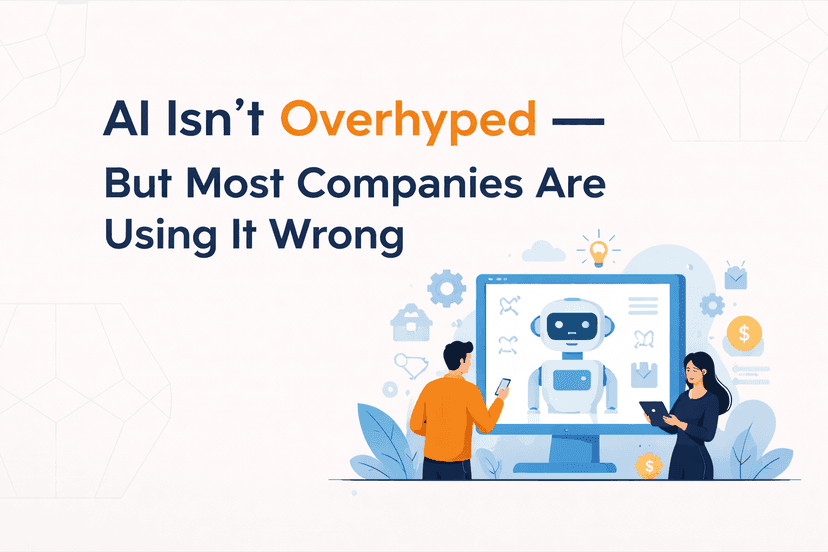
The narrative around Artificial Intelligence has shifted. We’ve moved from the "magic" of 2023 to the "disillusionment" of 2026. Critics point to high burn rates and lukewarm productivity gains as proof that AI was just another bubble.
But the data tells a different story. According to BCG’s 2025 Global Study, while 60% of companies report minimal value from their AI investments, the top 5%—the "future-built" firms—are seeing 1.7x higher revenue growth than their peers.
The problem isn't the technology. The problem is that most companies are treating AI as a software upgrade when they should be treating it as an organizational redesign.
The "Bolt-On" Fallacy
Most businesses use AI as a "bolt-on" tool—a slightly smarter autocomplete or a faster way to draft emails. While these use cases save a few minutes here and there, they don't move the needle on the bottom line.
As Andrew Ng, founder of DeepLearning.AI, famously noted:
"AI is the new electricity. Just as electricity transformed almost everything 100 years ago, today I actually have a hard time thinking of an industry which I don’t think AI will transform in the next several years."
But electricity didn't change the world because people plugged in a few lightbulbs; it changed the world because we redesigned factories and cities to leverage it. If you're just using AI to do your old tasks slightly faster, you’re missing the point.
From "Spectacle" to "Substance"
We are currently in a transition period. Microsoft CEO Satya Nadella highlighted this shift during the 2026 World Economic Forum, urging companies to move past the "abstract admiration" of tech:
"We have to get to a point where we are using [AI] to do something that changes the outcomes of people and communities and countries and industries... We are beginning to distinguish between spectacle and substance."
So, what does "substance" look like? It looks like Agentic Workflows.
The Shift to Software 3.0
In the past, we wrote code line-by-line (Software 1.0). Then, we trained models on data (Software 2.0). Now, as AI researcher Andrej Karpathy describes it, we are entering the era of Software 3.0, where the "code" is natural language and the "execution" is handled by AI agents.
In this new era, companies that "use AI right" follow three principles:
Solving Business Problems, Not Tech Problems: They don't ask "Where can we use AI?" They ask "Where is our biggest operational bottleneck?" and then see if AI is the right tool to solve it.
Redesigning the Workflow: They don't give a chatbot to a frustrated customer support agent. They redesign the support flow so the AI handles 80% of routine queries autonomously, allowing the human to act as a "high-level supervisor" for complex cases.
Investing in AI-Ready Data: AI is only as good as the proprietary data it consumes. Companies winning with AI have spent the last two years cleaning their data pipelines so their models aren't just reciting Wikipedia, but are actually "experts" on the company's specific business.
The Bottom Line
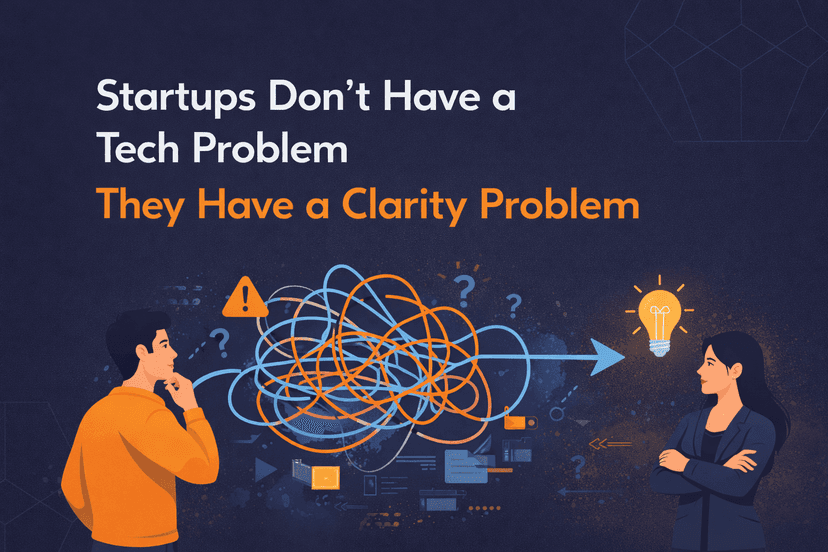
If your AI strategy feels like a series of "cool demos" that never make it to production, you are likely suffering from the Clarity Problem we discussed in our last post. AI doesn't fail because the models aren't smart enough; it fails because the business objectives aren't sharp enough.
The "hype" isn't the problem—the application is. Stop looking for a magic wand and start looking for a better blueprint.