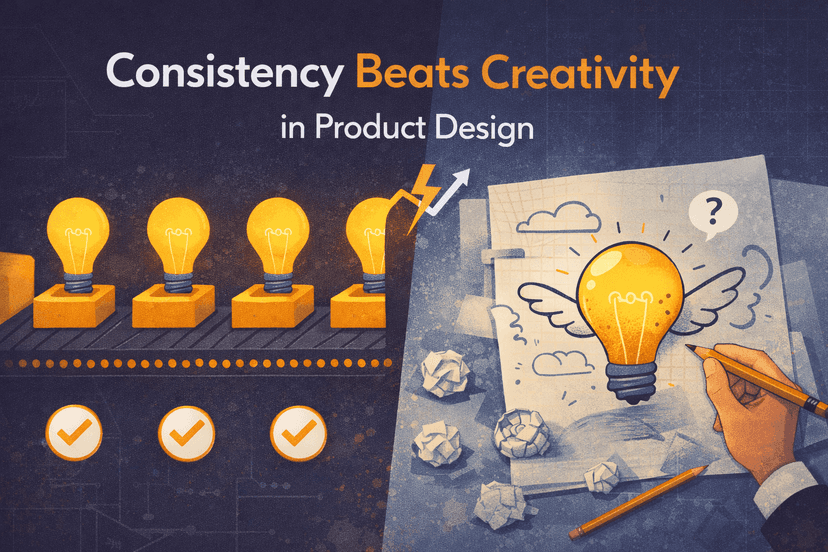
This topic is often a tough pill for "creative" types to swallow, but it is the bedrock of world-class user experience. In the world of art, "predictable" is an insult. In the world of product design, "predictable" is the ultimate compliment. The "new and shiny" is frequently the enemy of the "functional and familiar."
Many design teams fall into the trap of trying to reinvent the wheel with every new feature. They want to prove their creativity by designing a unique navigation menu, a bespoke checkout flow, or a revolutionary new way to scroll. But while the designers are admiring their own "creativity," the users are frustratedly looking for the "Home" button.
The hard truth? Users don’t want your product to be a unique journey of discovery. They want it to work exactly the way they expect it to.
Jakob’s Law: The User’s Mental Model
One of the most important principles in UX is Jakob’s Law, named after usability expert Jakob Nielsen. It states:
"Users spend most of their time on other sites. This means that users prefer your site to work the same way as all the other sites they already know."
When you break consistency—either with the rest of the internet or with your own app—you force the user to stop what they are doing and learn your new interface. This is called cognitive load. Every time a user has to think about how to use your product, they have less mental energy to spend on the actual value your product provides.
The Cost of "Creative" Friction
When "creativity" takes priority over consistency, the business pays the price in three ways:
Increased Support Burden: If your "creative" UI is confusing, your support team will spend their day explaining how to navigate the app instead of solving actual customer problems.
Lower Conversion Rates: In a checkout or signup flow, any moment of hesitation is a moment where a user might drop off. Predictability breeds trust; novelty breeds suspicion.
Engineering Debt: Every "unique" component requires custom code. A consistent design system uses reusable components, allowing developers to ship features 5x faster.
The Design System: Consistency at Scale
This is why companies like Google, Airbnb, and Shopify invest millions into Design Systems (like Material Design or Polaris). They aren't trying to stifle their designers; they are trying to ensure that a button in the "Settings" menu looks and acts exactly like a button in the "Cart."
As Brad Frost, author of Atomic Design, puts it:
"Consistency is one of the most powerful usability principles: when things always behave the same, users don't have to worry about what is going to happen."
Where Does Creativity Actually Belong?
Does this mean product design should be boring? Absolutely not. But you must be strategic about where you apply your creative energy.
Don't be creative with: Navigation, form inputs, button placement, or standard iconography (e.g., don't use a picture of a lightbulb for "Settings").
Do be creative with: Your brand’s visual identity, your unique value proposition, and the innovative way you solve the user's core problem. If you are building a fitness app, your "creativity" should go into how you motivate a user to run five miles—not into a revolutionary new way to click "Save."
The 80/20 Rule of Product Design
A good rule of thumb for product teams is the 80/20 Rule of Consistency:
80% of your UI should follow established patterns and your internal design system. It should be "invisible" so the user can flow through the task without thinking.
20% of your UI is where you can inject brand personality, delightful micro-interactions, and truly innovative features that set you apart from competitors.
Conclusion
Creativity is about solving problems in new ways. Design is about making those solutions accessible. If your user has to struggle to understand your "creative" interface, you haven't designed a better product—you’ve built a hurdle.
Build for the user’s habits, not for your portfolio. In the long run, the most "boring" products are often the ones that become indispensable.