We live in an age of infinite supply. If you want a task manager, there are 5,000 options. If you want a white t-shirt, there are 50,000. If you want a coffee shop, there are likely five within walking distance.
From a purely functional standpoint, most of these products are "good enough." They all do the job. So, why do we choose one over the rest? Why do some people insist on using Linear for project management, wearing Nike, or drinking Blue Bottle coffee?
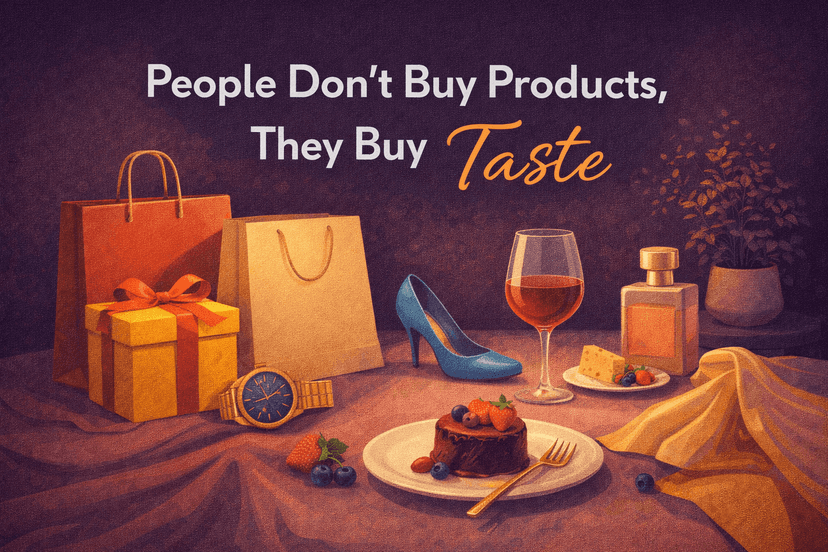
It isn’t because the features are 10x better. It’s because the brand has a specific point of view. People don't buy products; they buy the taste of the people who made them.
Curation is the New Value
In the past, value was created by access (Can you get the product?). Today, value is created by curation (Which product should you choose?).
Taste is the act of curation. It is the ability to say, "This belongs, and that doesn't." When a company has taste, it stops trying to please everyone and starts building for a specific "tribe." It moves from being a utility to being an identity.
As legendary music producer Rick Rubin writes in The Creative Act:
"Taste is the ability to see what’s there and what’s not there. It is the filter through which we experience the world. It’s not about being right or wrong; it’s about having a point of view."
The "Identity" Premium
When a customer buys a product with high "taste," they are actually buying a reflection of who they want to be.
You don't buy an Apple Watch Ultra just to track your steps; you buy it because you identify with the "rugged explorer" aesthetic.
You don't use Arc Browser just to see websites; you use it because you identify as someone who values "the future of the web" and cutting-edge craft.
This is what Seth Godin refers to when he says:
"People like us do things like this."
Taste is the signal that tells the customer: "This product was made by someone who sees the world the same way you do."
Why Features are a Commodity (and Taste is a Moat)
Technical features are easily copied. If you launch a "Story" feature on Instagram, Snapchat and LinkedIn will have it within six months. If you lower your price, your competitor will match it tomorrow.
But you cannot copy taste. Taste is the "soul" of the product. It is the specific way a button clicks, the specific tone of the copywriting, and the specific things the product refuses to do. Taste is the ultimate moat because it is deeply human and impossible to automate. You can't A/B test your way to great taste; you have to have a conviction about what is beautiful and what is "right."
How to Build "Taste" Into Your Company
If you want your brand to be more than a commodity, you have to move beyond the spreadsheet:
Hire for Point of View: Don't just hire the person with the most years of experience; hire the person who has a strong opinion on what makes a "good" product.
Stop A/B Testing Everything: Data can tell you how to optimize a button, but it cannot tell you how to build a brand people love. Some decisions must be made because they "feel right" to the curator.
Narrow Your Focus: Taste requires exclusion. If you try to appeal to everyone, your brand will become "beige." To have taste, you must be willing to be "too much" for some people so you can be "exactly right" for others.
Conclusion
The market is tired of "optimized" products that feel like they were designed by a committee. The world is hungry for products that feel like they were made by someone. If you want to win in 2026 and beyond, stop competing on features. Start competing on taste.