For decades, the physical art world was governed by geography. If you were a talented digital illustrator in Nairobi or a 3D animator in Dakar, your path to a global gallery was blocked by visas, shipping costs, and the "gatekeepers" of the traditional Western canon.
Digital art has demolished those walls.
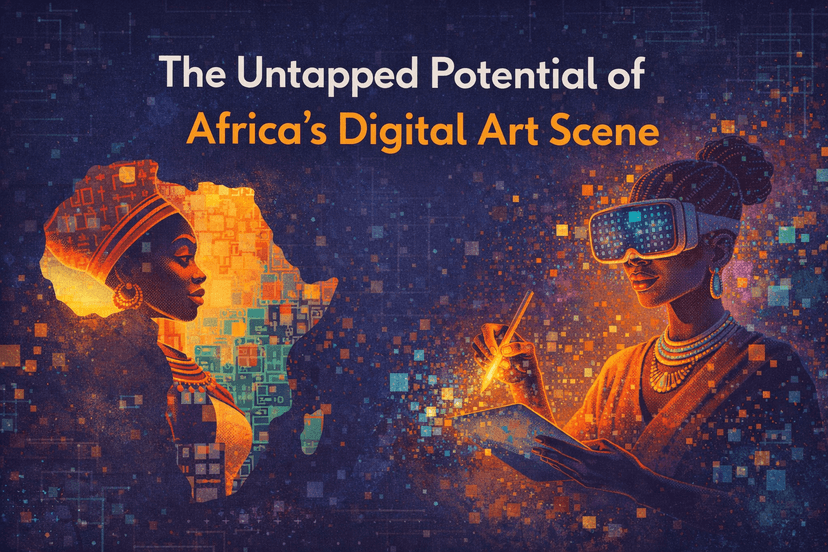
Across the African continent, a "Digital Renaissance" is unfolding. It is driven by the world’s youngest population, rapid mobile penetration, and a cultural tradition of storytelling that is now finding its expression in pixels, code, and virtual reality. The potential isn't just "emerging"—it is exploding, yet it remains one of the most undervalued sectors in the global art ecosystem.
The "Leapfrog" Effect
Just as many African nations bypassed landline telephony to go straight to mobile, African artists are bypassing traditional "oil on canvas" gatekeeping to lead in digital mediums. For a creator in a high-growth hub like Lagos or Johannesburg, a laptop and an internet connection are the only "studio" required to reach a collector in Tokyo or Zurich.
As Prince Jacon, a prominent Nigerian digital artist and curator, has noted:
"Digital art is the great equalizer for the African creator. It allows us to bypass the physical barriers of the traditional art world and speak directly to a global audience. Our stories are no longer confined by borders; they are transmitted in real-time."
Beyond the NFT Hype: Cultural Sovereignty
While the 2021–2022 NFT craze brought a temporary spotlight to African digital creators (like Osinachi or Anthony Azekwoh), the real untapped potential lies in Cultural Sovereignty.
Digital art allows African creators to reclaim and digitize their own heritage. We are seeing:
Afrofuturism in 3D: Artists reimagining African history through a sci-fi lens, creating digital worlds that challenge colonial narratives.
Generative Art & Indigenous Patterns: Programmers using algorithms to translate traditional weaving patterns and fractals into generative digital masterpieces.
AI as a Collaborator: Using Artificial Intelligence to synthesize diverse African aesthetics, creating a new visual language that is distinctly modern yet deeply rooted.
The Institutional Opportunity
The global art market is currently playing catch-up. While major Western institutions like the LACMA and the Centre Pompidou have begun acquiring digital works, they have barely scratched the surface of the African scene.
The "untapped" nature of this market offers a unique entry point for visionary collectors. Currently, the "Price-to-Talent" ratio in Africa’s digital art scene is skewed. You have world-class animators and digital painters whose work carries immense cultural weight but is priced at a fraction of their Western counterparts.
Beeple (Mike Winkelmann), whose $69 million sale ignited the digital art explosion, famously said:
"Digital art is just as valid as any other form of art... It’s about the emotional connection and the story being told."
In the African context, those stories are incredibly rich, largely untold on the global stage, and ready for a digital-first audience.
The Infrastructure Gap: The Final Hurdle
To unlock this potential, the ecosystem needs more than just talented artists. It requires:
Local Digital Galleries: Physical spaces on the continent dedicated to displaying digital screens and VR experiences to build a local collector base.
Education & Mentorship: Bridging the gap between "commercial digital work" (graphic design/advertising) and "fine digital art."
Bandwidth & Hardware: Lowering the cost of high-end GPUs and stable internet, which remain the primary "overhead" for these creators.
Conclusion
The African digital art scene is the "Silicon Valley" of the art world—high innovation, high growth, and currently flying under the radar of the traditional establishment.
We are moving toward a future where "African Art" isn't defined by where it is shipped from, but by the digital pulse of the people who created it. The collectors and institutions that recognize this now aren't just buying files; they are investing in the digital heritage of the future.