In the mid-2010s, a narrative took hold of the software industry: if you wanted to be a "serious" tech company, you had to use microservices. We looked at Netflix, Amazon, and Google, saw their thousands of tiny, decoupled services, and decided that was the "correct" way to build software.
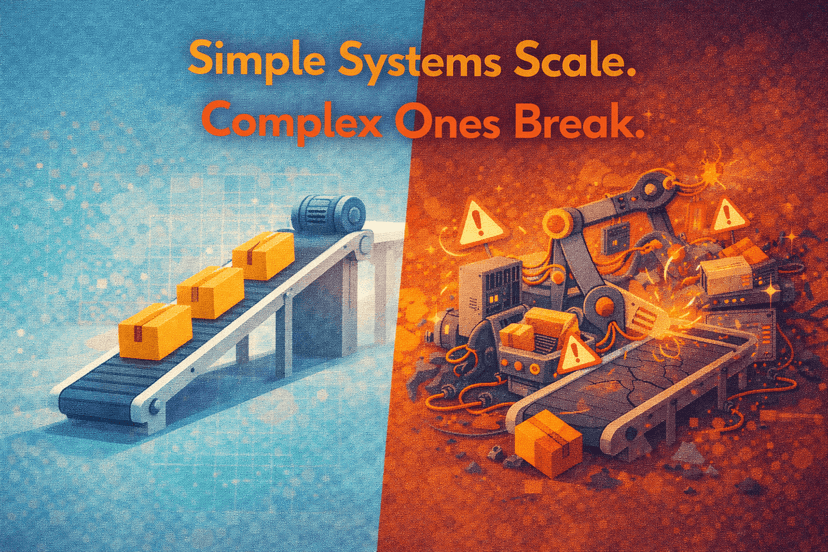
Fast forward to today, and many startups are strangled by the very architecture that was supposed to set them free. They have five developers and fifty microservices. They spend more time managing network latency and distributed transactions than they do shipping features.
The hard truth? Microservices are a solution to an organizational problem, not a technical one. If your team is small, a monolith isn't a limitation—it’s a superpower.
The "Microservice Premium"
Every architectural choice is a trade-off. When you move from a monolith (one single codebase) to microservices (many small codebases talking over a network), you aren't just "scaling"—you are paying what Martin Fowler calls the "Microservice Premium."
"The first rule of distributed objects is: Don't distribute your objects... You should only consider microservices when you have a system that is too complex to manage as a monolith."
The "Premium" is the massive increase in operational complexity. Suddenly, you need:
Advanced Observability: You can’t just look at one log file; you need distributed tracing to find out why a request failed.
Network Reliability: You have to handle "partial failures" where Service A is up, but Service B is slow, and Service C is down.
Deployment Overhead: Instead of one deployment pipeline, you have dozens.
If you don't have hundreds of developers, the cost of this "Premium" will almost always outweigh the benefits.
Solving the Wrong Problem
Microservices were designed to solve organizational contention. At a company like Amazon, you can’t have 5,000 developers trying to commit code to the same repository every hour. They would step on each other's toes constantly. Microservices allow these teams to move independently.
But if you are a startup with a team of ten, you don't have an "organizational contention" problem. You have a "speed to market" problem. In a monolith, refactoring is easy, sharing code is trivial, and debugging is straightforward. In a microservices environment, a simple change to a data schema can require coordinating updates across five different services.
As Sam Newman, author of Building Microservices, warns:
"Microservices should be a last resort, not a first choice. If you can build it as a monolith, you probably should."
The "Distributed Monolith" Trap
Many teams attempt microservices but end up with the worst of both worlds: the Distributed Monolith. This happens when services are so tightly coupled that you can't change one without changing the others. You have all the complexity of a distributed system, but none of the independent deployability. You’ve essentially taken your "spaghetti code" and put it on a network, making it slower, harder to test, and more expensive to host.
The Case for the "Majestic Monolith"
A well-structured monolith is not "old-fashioned"—it is efficient. It allows your team to:
Move Fast: Change the database schema and the UI in the same commit.
Reduce Costs: No need for complex service meshes or massive cloud bills for inter-service traffic.
Simplify Onboarding: A new hire can clone one repo and run the whole app on their laptop.
When SHOULD You Move to Microservices?
You should only consider breaking apart your monolith when:
The Team Outgrows the Repo: When different departments are constantly blocking each other’s deployments.
Differing Resource Needs: When one part of your app needs 64GB of RAM to process images, but the rest of the app only needs 1GB.
True Independent Scaling: When one specific feature gets 100x the traffic of the rest of the site.
Conclusion
Don’t build for the scale you hope to have in five years; build for the scale you have today. If your business fails because you couldn't ship features fast enough, it won't matter that your architecture could have handled a billion users.
Choose the architecture that lets you execute. For 90% of products, that is a clean, well-tested monolith.