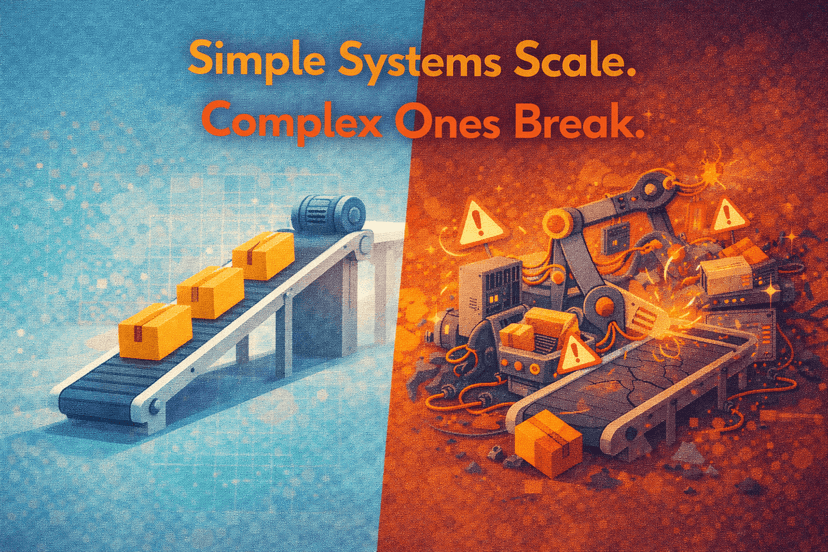
There is a common misconception in the business world that "scaling" means adding more: more features, more layers of management, more sophisticated tech stacks, and more intricate processes.
We assume that a "big" company requires "big" complexity.
The reality is exactly the opposite. Complexity is the friction that slows you down; simplicity is the fuel that lets you go fast. If you want to build something that can survive 10x or 100x growth, you don't build a complex system. You build a simple system that is easy to replicate.
Gall’s Law: The Golden Rule of Systems
One of the most profound observations in systems theory comes from John Gall in his 1975 book, Systemantics. It is known as Gall’s Law:
"A complex system that works is invariably found to have evolved from a simple system that worked. A complex system designed from scratch never works and cannot be patched up to make it work. You have to start over with a working simple system."
If you try to build a "scale-ready" complex system on Day 1, you will fail. Why? Because you cannot predict the "edge cases" of a system you haven't even launched yet. When a simple system fails, the point of failure is obvious. When a complex system fails, the cause is often a "cascading error"—a ghost in the machine that takes days of forensic analysis to find.
The Fragility of "Clever" Solutions
In both engineering and management, there is a dangerous temptation to be "clever."
In Tech: Using an obscure programming language or a highly specialized database because it’s "theoretically faster."
In Business: Creating a 12-step approval process for a $50 expense to "ensure fiscal responsibility."
These clever solutions create tight coupling. Tight coupling means that Part A cannot function without Part B, which is dependent on Part C. If Part C breaks, the entire engine seizes.
A simple system is decoupled. It consists of small, "boring" parts that do one thing well. If one part breaks, you swap it out without the whole building falling down. As the saying goes in the DevOps world: "Complexity is a debt that you pay back in downtime."
Why Simplicity is Scalable
Scaling is essentially the act of multiplication.
If you have a simple, documented process for onboarding a client, you can hire 10 people to do it.
If your onboarding process is a 50-page manual filled with "if/then" exceptions that only the founder understands, you can't hire anyone to do it. You are the bottleneck.
Complexity is unique; simplicity is universal. You can scale a McDonald's because the system is simple enough for a teenager to run. You cannot scale a five-star Michelin restaurant in the same way because the system relies on the "complex" genius of a single chef.
The "Boring Technology" Manifesto
In 2015, Dan McKinley (an early Etsy engineer) wrote a famous essay titled "Choose Boring Technology." His argument was simple: every company has a limited amount of "innovation tokens."
"Mindshare is a finite resource... If you use a 'cool' new database, you've spent an innovation token. Now you have to learn how it fails, how to back it up, and how to fix it when it breaks."
If you spend all your "innovation tokens" on your infrastructure or your complex internal processes, you have no tokens left to spend on the thing that actually matters: your product.
How to Enforce Simplicity
The "Three D's": Delete it, Delegate it, or De-complicate it. If a step in a process doesn't add 10x value, remove it.
Standardize the "Boring" Stuff: Use the most common tools, the most standard languages, and the most basic org charts. Save your creativity for the problem you are solving for the customer.
Audit for "Hidden Complexity": Every six months, ask your team: "What is the hardest part of your job?" If the answer is "navigating our internal systems," you have a complexity problem.
Conclusion
Complexity feels like sophisticated progress, but it is actually a form of organizational rot. Simple systems are resilient, they are understandable, and—most importantly—they are scalable.
If you want to reach the stars, don't build a 1,000-story skyscraper on a shaky foundation. Build a launchpad that is so simple, it’s impossible to break.